| 書目名稱 | Seeking Chances |
| 副標(biāo)題 | From Biased Rational |
| 編輯 | Emanuele Bardone |
| 視頻video | http://file.papertrans.cn/864/863762/863762.mp4 |
| 概述 | Stimulates a discussion about the idea of human cognition as a chance-seeking system.Novel insights about how to treat some issue pertaining to decision making and problem solving.Written by a leading |
| 叢書名稱 | Cognitive Systems Monographs |
| 圖書封面 | 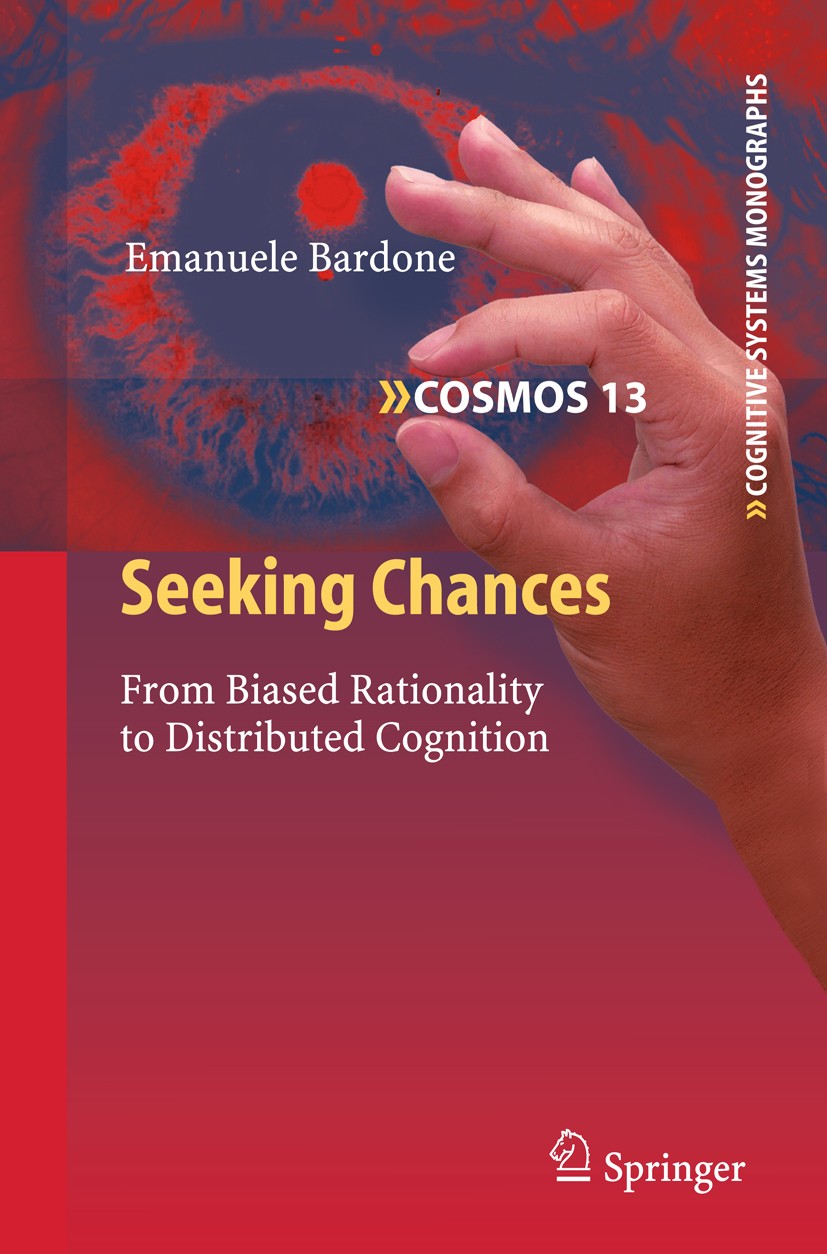 |
| 描述 | .One of the most distinguishing abilities that human beings display is the ability of turning almost everything into a clue to make a problem affordable in relation to what one knows and, most of all, to what one does not know. That is what characterizes humans as chance seekers. A poor pattern of reasoning and even our ignorance may help us make a decision, and eventually solve a problem. This is the rationale of biased rationality. However, not everything leads us always to a good decision. Some people are not satisfied with weak arguments or it-is-just-so strategies. They want something better. This second attitude points to a different form of rationality that takes advantage of the idea of distributed cognition. Basically, human beings improve their survival strategies by building cognitive niches capable of delivering potentially ever more symptomatic information. It is through various manipulations of the environment that we gain new and more reliable chances which can be used to de-bias our rationality. Through the laborious activity of cognitive niche construction, we come up with situations in which we are better afforded by our environment, and thus biases or fallacies c |
| 出版日期 | Book 2011 |
| 關(guān)鍵詞 | Abduction; Affordance; Bias; Bounded Rationality; Cognitive Niche; Distributed Cognition; Fallacy |
| 版次 | 1 |
| doi | https://doi.org/10.1007/978-3-642-19633-1 |
| isbn_softcover | 978-3-642-26783-3 |
| isbn_ebook | 978-3-642-19633-1Series ISSN 1867-4925 Series E-ISSN 1867-4933 |
| issn_series | 1867-4925 |
| copyright | Springer Berlin Heidelberg 2011 |


 |Archiver|手機版|小黑屋|
派博傳思國際
( 京公網(wǎng)安備110108008328)
GMT+8, 2026-1-20 13:08
|Archiver|手機版|小黑屋|
派博傳思國際
( 京公網(wǎng)安備110108008328)
GMT+8, 2026-1-20 13:08






 發(fā)表于 2025-3-21 17:36:48





