| 書(shū)目名稱 | Introduction to Scientific Programming with Python |
| 編輯 | Joakim Sundnes |
| 視頻video | http://file.papertrans.cn/475/474151/474151.mp4 |
| 概述 | Practical and example-based presentation quickly enables readers to start writing their own programs.The book combines practical tools of computational science with fundamental and generic programming |
| 叢書(shū)名稱 | Simula SpringerBriefs on Computing |
| 圖書(shū)封面 | 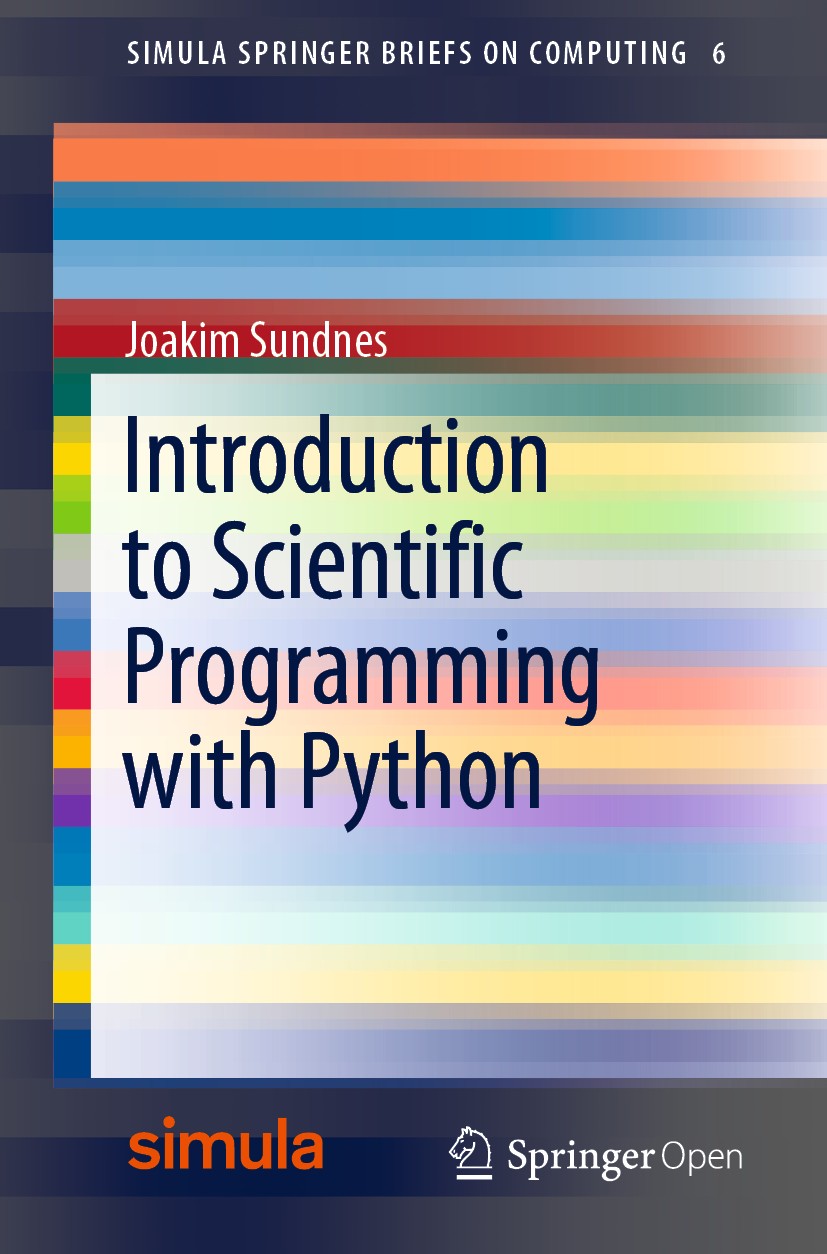 |
| 描述 | .This open access book offers an initial introduction to programming for scientific and computational applications using the Python programming language. The presentation style is compact and example-based, making it suitable for students and researchers with little or no prior experience in programming. . .The book uses relevant examples from mathematics and the natural sciences to present programming as a practical toolbox that can quickly enable readers to write their own programs for data processing and mathematical modeling. These tools include file reading,?plotting, simple text analysis, and using NumPy for numerical computations, which are fundamental building blocks of all programs in data science and computational science. At the same time, readers are introduced to the fundamental concepts of programming, including variables, functions, loops, classes, and object-oriented programming. Accordingly, the book provides a sound basis for further computer science and programming studies..?. .?. |
| 出版日期 | Book‘‘‘‘‘‘‘‘ 2020 |
| 關(guān)鍵詞 | programming; Python; computational science; data science; object oriented programming; open access |
| 版次 | 1 |
| doi | https://doi.org/10.1007/978-3-030-50356-7 |
| isbn_softcover | 978-3-030-50355-0 |
| isbn_ebook | 978-3-030-50356-7Series ISSN 2512-1677 Series E-ISSN 2512-1685 |
| issn_series | 2512-1677 |
| copyright | The Editor(s) (if applicable) and The Author(s) 2020 |


 |Archiver|手機(jī)版|小黑屋|
派博傳思國(guó)際
( 京公網(wǎng)安備110108008328)
GMT+8, 2026-1-21 01:25
|Archiver|手機(jī)版|小黑屋|
派博傳思國(guó)際
( 京公網(wǎng)安備110108008328)
GMT+8, 2026-1-21 01:25






 發(fā)表于 2025-3-21 16:20:11










