| 書目名稱 | Incompatibility in Fungi | | 副標(biāo)題 | A Symposium held at | | 編輯 | Karl Esser,John R. Raper | | 視頻video | http://file.papertrans.cn/464/463316/463316.mp4 | | 圖書封面 | 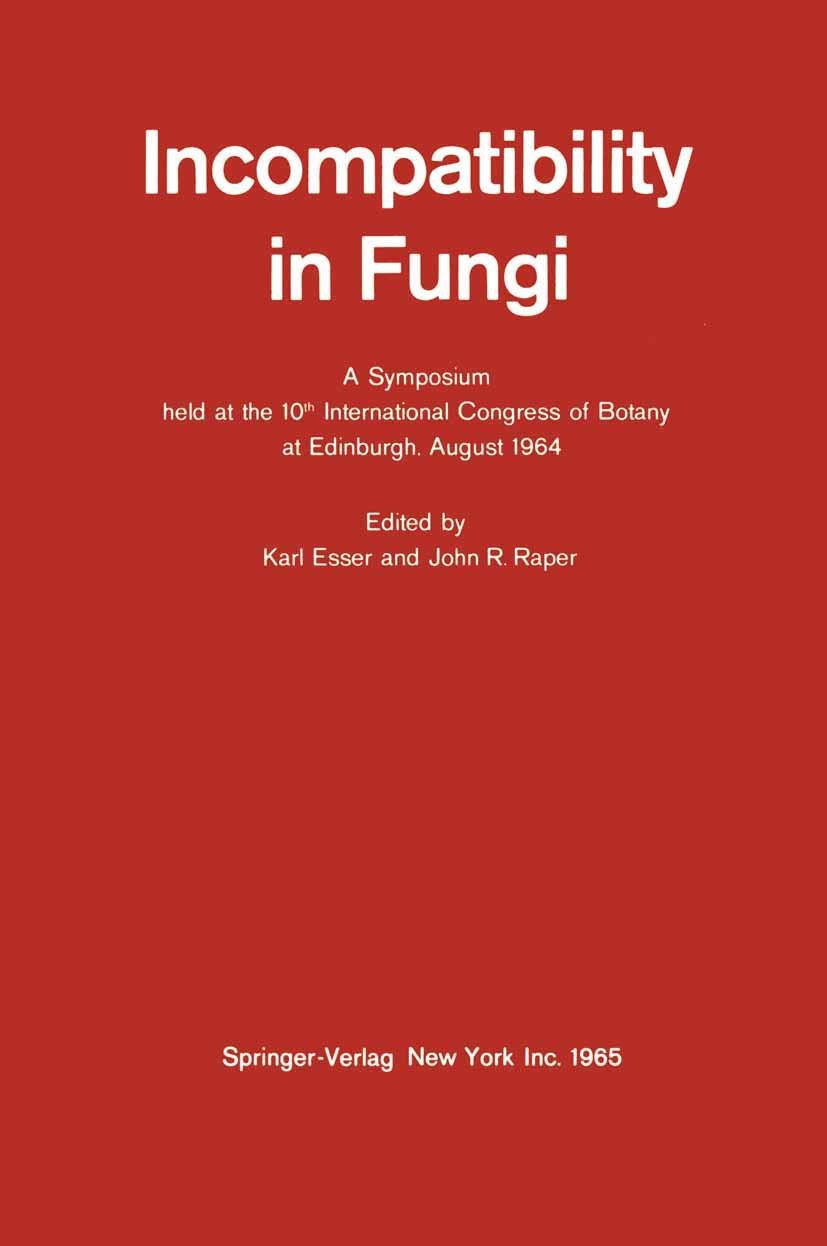 | | 描述 | Sexual reproduction in the fungi is extensively regulated by incom- patibility, which determines, in the absence of any morphological differ- entiation, the pattern of mating among individual strains. Control of the interactions that comprise the sexual reproductive process resides in specific genetic factors, the incompatibility factors, which occur in several distinct systems in the various groups of fungi and which exert their control in two basically different ways. On the one hand, the system may play the same role as dioecy in higher organisms by restricting or preventing inbreeding among the members of the same race (homo genic incompatibility) and thus enhance outbreeding. On the other hand, the system may impose the opposite effect by restricting or preventing interbreeding between members of different races (heterogenic incompatibility) and thus promote inbreeding. In addition to these basic facts concerning the general biological signi- ficance of incompatibility, important advances have been made in recent years, especially in the investigation of the genetics of incompatibility systems. Sufficient information concerning the genetic determination of incompatibility is n | | 出版日期 | Book 1965 | | 關(guān)鍵詞 | Ascomycetes; Basidiomycetes; fungi; genes; genetics; reproduction | | 版次 | 1 | | doi | https://doi.org/10.1007/978-3-642-87052-1 | | isbn_softcover | 978-3-540-03334-9 | | isbn_ebook | 978-3-642-87052-1 | | copyright | Springer-Verlag Berlin · Heidelberg 1965 |
The information of publication is updating

|
|


 |Archiver|手機(jī)版|小黑屋|
派博傳思國際
( 京公網(wǎng)安備110108008328)
GMT+8, 2026-1-25 22:38
|Archiver|手機(jī)版|小黑屋|
派博傳思國際
( 京公網(wǎng)安備110108008328)
GMT+8, 2026-1-25 22:38






 發(fā)表于 2025-3-21 18:10:39