| 書(shū)目名稱(chēng) | How is Society Possible? | | 副標(biāo)題 | Intersubjectivity an | | 編輯 | Steven Vaitkus | | 視頻video | http://file.papertrans.cn/429/428729/428729.mp4 | | 叢書(shū)名稱(chēng) | Phaenomenologica | | 圖書(shū)封面 | 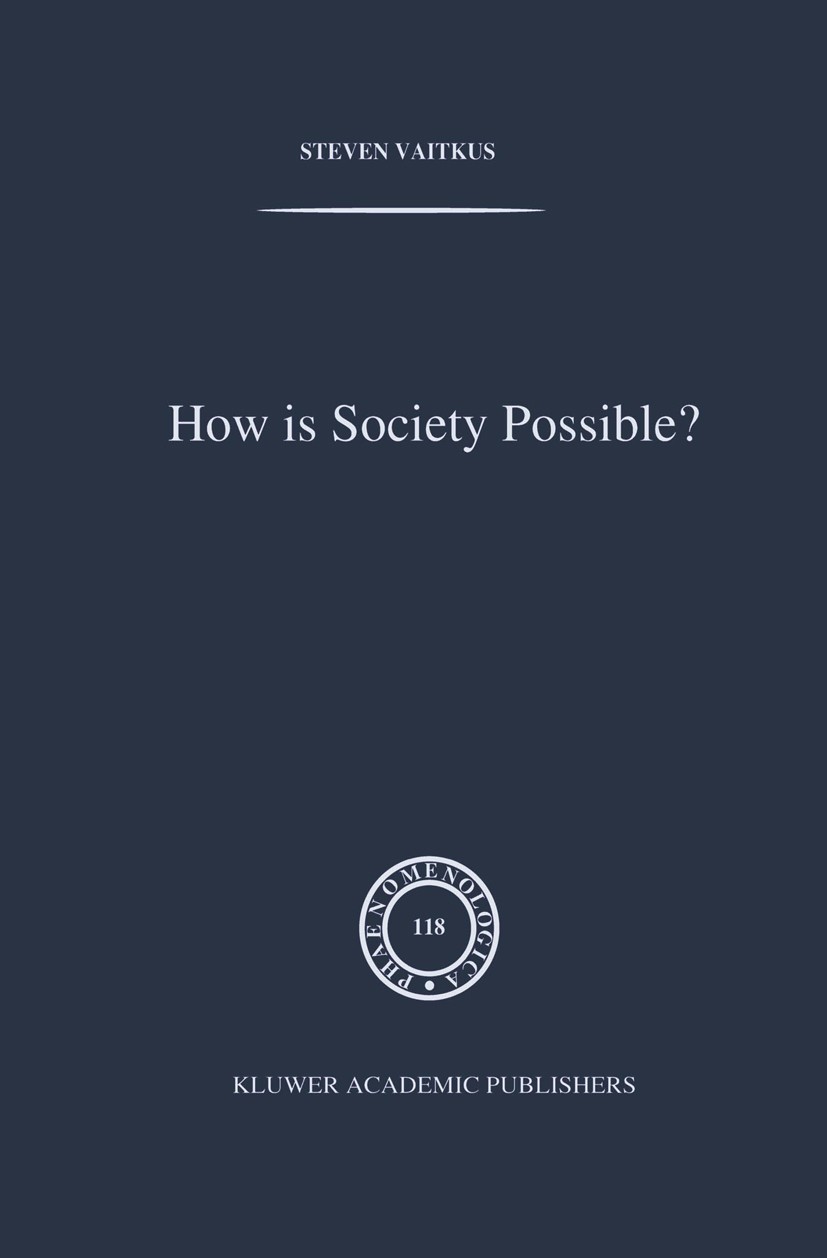 | | 描述 | How is society possible? In Die Krisis der europiiischen Wissenschaflen und die transzendentale Phiinomenoiogie, I Edmund Husserl is found with a pathos send- ing out pleas for belief ("Glauben") in his transcendental philosophy and tran- scendental ego. The traditional idea of theoretical reflection instituted in ancient Greece as the suspension of all taken for granted worldly interests has, through a partial realization of itself, forsaken itself in the one-sided development of the objective mathematical-natural sciences as they themselves have become so taken for granted, with the method and validity of their results held as so self-evident, that they appear as resting self-sufficiently on their own grounds, while pursuing an increasingly abstract mathematization of nature. The sciences are left without a foundation and their meaning within the world consequently unintelligible, while their objective and valid abstract concepts continually tend to supercede the everyday life-world and render it questionable. In the end, these of belief in the everyday life-world or reflective evolving and exchanging attitudes doubt (science) ultimately leads to a disbelief in both, and a search | | 出版日期 | Book 1991 | | 關(guān)鍵詞 | Aron Gurwitsch; Evolution; Institution; Milieu; Transformation; concept; phenomenology | | 版次 | 1 | | doi | https://doi.org/10.1007/978-94-009-2077-4 | | isbn_softcover | 978-94-010-7432-2 | | isbn_ebook | 978-94-009-2077-4Series ISSN 0079-1350 Series E-ISSN 2215-0331 | | issn_series | 0079-1350 | | copyright | Kluwer Academic Publishers 1991 |
The information of publication is updating

|
|


 |Archiver|手機(jī)版|小黑屋|
派博傳思國(guó)際
( 京公網(wǎng)安備110108008328)
GMT+8, 2025-10-8 03:52
|Archiver|手機(jī)版|小黑屋|
派博傳思國(guó)際
( 京公網(wǎng)安備110108008328)
GMT+8, 2025-10-8 03:52






 發(fā)表于 2025-3-21 16:39:28